
Whether you’re enjoying a craft lager, a velvety Merlot, or a refined single malt, you’re consuming ethanol, the sole potable alcohol in all alcoholic beverages. This compound, measured by Alcohol by Volume (ABV), appears in different concentrations: beer typically ranges from 3, 7%, wine from 9, 16%, and spirits from 40, 95%. Each standard serving delivers approximately 0.6 ounces of pure ethanol, creating equivalent effects despite varying pour sizes. Understanding how each beverage achieves its distinctive strength reveals fascinating production nuances. Whether you’re enjoying a craft lager, a velvety Merlot, or a refined single malt, you’re consuming ethanol, the sole potable alcohol in all alcoholic beverages. This compound, measured by Alcohol by Volume (ABV), appears across different types of alcohol in varying concentrations: beer typically ranges from 3, 7%, wine from 9, 16%, and spirits from 40, 95%. Each standard serving delivers approximately 0.6 ounces of pure ethanol, creating equivalent physiological effects despite differing pour sizes. Understanding how each beverage achieves its distinctive strength reveals fascinating production nuances. Whether you’re enjoying a craft lager, a velvety Merlot, or a refined single malt, you’re consuming ethanol, the sole potable alcohol in all alcoholic beverages, a fact that underscores the ethanol vs methanol difference in terms of safety and metabolism. This compound, measured by Alcohol by Volume (ABV), appears in varying concentrations: beer typically ranges from 3, 7%, wine from 9, 16%, and spirits from 40, 95%. Each standard serving delivers approximately 0.6 ounces of pure ethanol, creating equivalent physiological effects despite differing pour sizes. Understanding how each beverage achieves its distinctive strength reveals fascinating production nuances rooted in fermentation and distillation rather than the type of alcohol itself.
Every Beer, Wine, and Liquor Contains the Same Alcohol
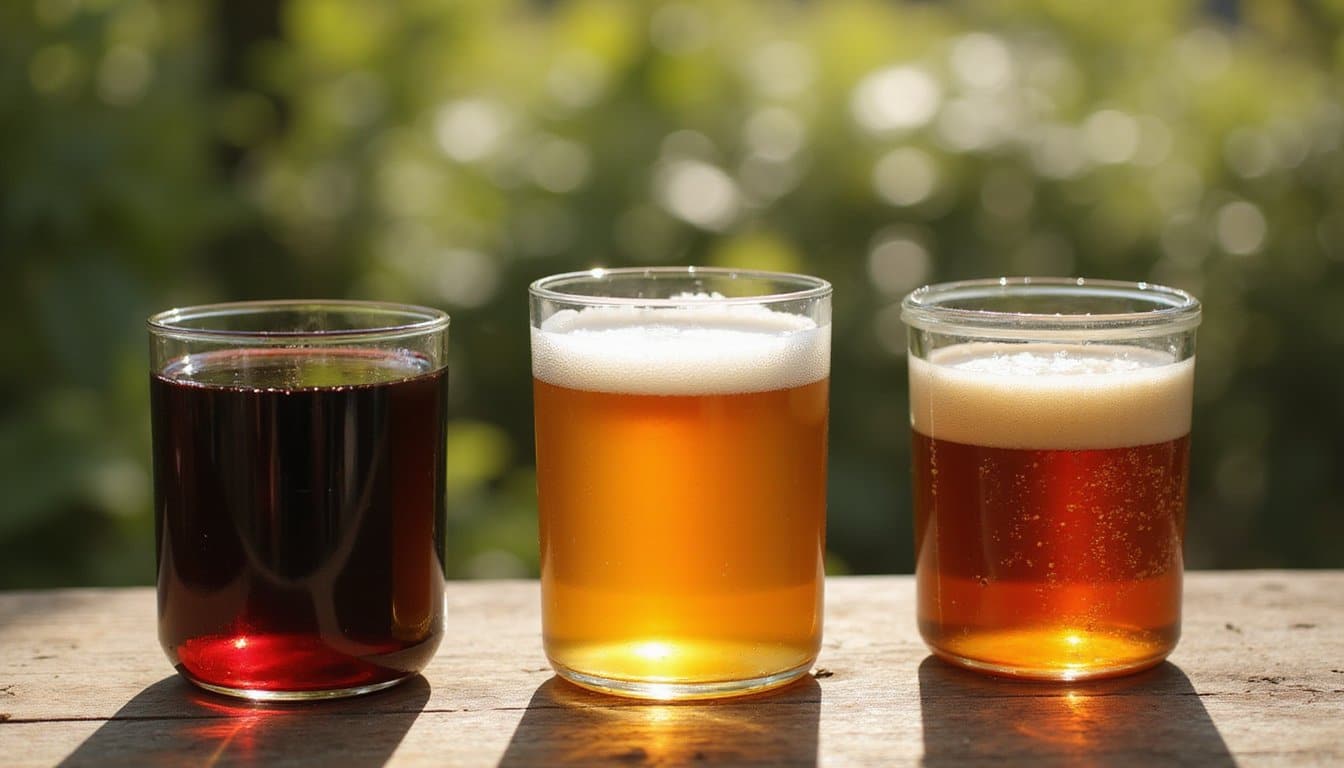
When you break down the chemistry behind your favorite drinks, you’ll discover that beer, wine, and liquor all share an identical alcoholic foundation: ethanol. This potable alcohol, sometimes called EtOH alcohol, represents the type of alcohol found in alcoholic beverages that makes you drunk. Whether you’re sipping craft beer or aged whiskey, you’re consuming the same drinkable ethyl alcohol. The strength of these beverages is measured using ABV, which stands for Alcohol by Volume and indicates the percentage of ethanol present in the liquid. While most alcoholic beverages contain ethanol concentrations that typically range from 4% to over 40%, the question arises whether can alcohol be 100 percent pure. Pure ethanol, often used in laboratories and industrial applications, can reach nearly complete purity but is not suitable for consumption. High-proof spirits like absinthe or grain alcohol can also come close to this threshold, but they still contain trace amounts of water and other compounds.
Why One Shot Equals One Beer Equals One Glass of Wine
Though the vessels differ dramatically in size, a pint glass, a wine goblet, a shot glass, each standard serving delivers precisely 0.6 ounces of pure ethanol to your system. This equivalence stems from a simple calculation: volume multiplied by alcohol by volume percentage yields identical results across all three beverages.
| Beverage | Standard Pour | ABV |
|---|---|---|
| Beer | 12 ounces | 5% |
| Wine | 5 ounces | 12% |
| Liquor | 1.5 ounces | 40% |
You’ll notice the inverse relationship between concentration and serving size. Beer’s modest ABV demands a larger pour, while spirits’ potent distillation requires mere restraint. Wine occupies the elegant middle ground. Understanding this mathematical harmony empowers you to track consumption accurately, regardless of whether you’re savoring a robust ale or a refined bourbon. Because standard serving sizes are equal in alcohol strength, they produce equivalent effects on the body. In the United States, each of these standard servings contains 14 grams of pure alcohol, establishing the baseline for comparing drinks across categories.
How Beer Gets Its 3, 7% Alcohol Content
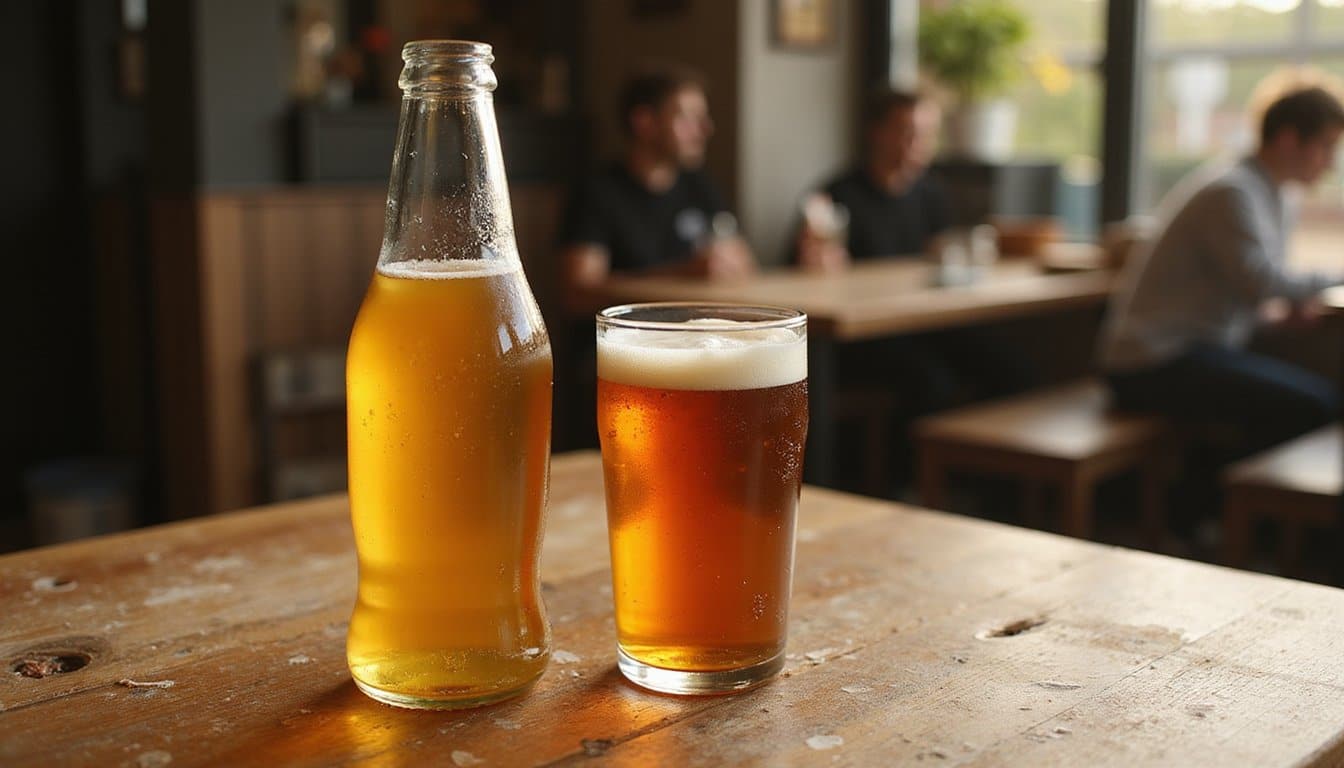
When you brew beer, yeast serves as the primary catalyst, metabolizing fermentable sugars from malted grains into ethanol and carbon dioxide. Your choice of ingredients, particularly the malt bill and any adjunct sugars, establishes the wort’s original gravity, which determines the maximum alcohol potential your fermentation can achieve. The duration of fermentation then dictates how thoroughly yeast consumes available sugars, ultimately landing your beer within that characteristic 3, 7% ABV range. A richer wort provides yeast with more material to convert, raising the alcohol ceiling, while a leaner sugar profile keeps ABV lower. Beers with higher attenuation finish drier and crisper because yeast has consumed more of the available sugars, whereas those with more unfermentable sugars retain a fuller body.
Yeast Converts Sugars
How exactly does a simple grain-based liquid transform into the crisp, intoxicating beverage we recognize as beer? The answer lies in yeast’s remarkable metabolic machinery. When you introduce yeast to oxygen-rich wort, these single-celled organisms multiply rapidly before shifting their focus to sugar consumption.
During primary fermentation, yeast breaks down fermentable sugars, maltose, glucose, and fructose, converting them into ethanol and carbon dioxide. You’ll notice vigorous bubbling as CO2 escapes, signaling active alcohol production. Ales typically ferment at 62-75°F, while lagers require cooler temperatures between 46-58°F to achieve their characteristic clean profiles.
The process doesn’t stop there. Secondary fermentation allows remaining sugars to transform while yeast absorbs undesirable compounds like diacetyl. Finally, conditioning at 31-38°F encourages yeast flocculation and flavor refinement. Standard brewer’s yeast strains tolerate 3-5% ABV, naturally limiting most beers to that familiar 3-7% range without requiring intervention. The amount of sugar in the wort directly determines the final ABV, as high-sugar brews give yeast more fuel to produce stronger beers.
Brewing Ingredients Matter
Every ingredient in your beer contributes to its final alcohol content, though some play more direct roles than others. Base malts like two-row barley supply the fermentable sugars that yeast transforms into ethanol, while specialty grains add color and viscosity without considerably boosting ABV. You’ll find pale lagers and pilsners averaging 3, 5% ABV precisely because lighter malts yield modest sugar concentrations.
Hops, despite their aromatic complexity, don’t influence alcohol levels, their alpha acids contribute bitterness and antimicrobial stability instead. Historically, hops replaced gruit and other vegetation as a superior preservation method for beer. Your yeast selection proves critical: lager strains typically stall at 4, 6% ABV, while ale yeasts tolerate higher concentrations. Different yeast strains have varying alcohol tolerance levels, which explains why certain beers can reach significantly higher percentages than others. Water, comprising over 99% of your beer, supports enzymatic extraction during mashing at temperatures between 144, 170°F. Each ingredient’s precise contribution determines whether you’re crafting a sessionable pilsner or a robust ale.
Fermentation Time Limits
Although yeast strains determine your beer’s flavor profile, fermentation duration ultimately governs how much ethanol accumulates in your final brew. Ale yeasts operate vigorously at 70°F, converting sugars to alcohol within 7-14 days. Lager yeasts, working at cooler 55°F temperatures, require 4-8 weeks to achieve comparable results.
You’ll find that standard beers reach their characteristic 3-7% ABV through precise timing. A 4% pale ale completes primary fermentation in 8-14 days, while higher-gravity styles demand extended periods. Barley wines approaching 10-12% ABV may ferment for seven months as yeast laboriously processes abundant sugars. This explains why lager beers can take 6-12 months to make due to their longer conditioning requirements.
Temperature adjustment proves essential, reducing 3-5°F at 50-60% attenuation shifts your brew between fermentation stages. This calculated approach maintains consistent alcohol content while respecting yeast tolerance thresholds that naturally cap ethanol production. Before fermentation can begin, the wort must undergo rapid cooling after boiling to create optimal conditions for yeast introduction.
Why Wine Packs More Punch at 9, 16% ABV
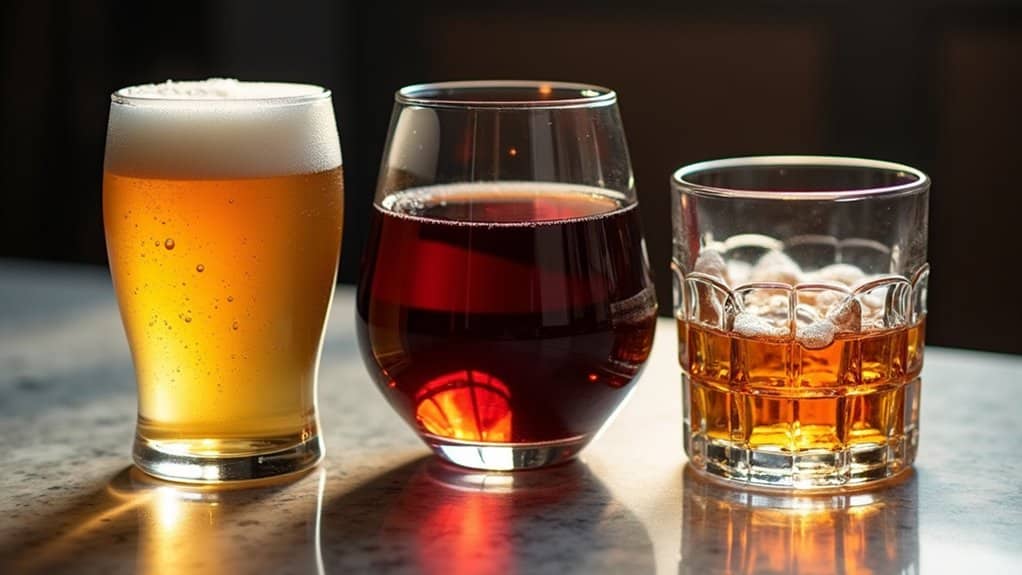
When you sip wine, you’re experiencing the elegant result of extended fermentation, where yeast transforms grape sugars into ethanol over a longer period than beer’s brief brewing cycle. The natural sugar concentration in wine grapes, particularly those harvested from sun-drenched vineyards, gives winemakers a richer canvas for alcohol development, often pushing ABV well beyond beer’s modest percentages. This higher alcohol content contributes to a creamier, more viscous mouthfeel that distinguishes full-bodied wines from lighter beverages. You’ll also encounter fortified styles like Port and Sherry, where the strategic addition of brandy elevates the alcohol content to an impressive 16, 24% ABV.
Extended Fermentation Boosts Alcohol
Wine’s ability to reach 9, 16% ABV stems from an extended fermentation process that allows yeast to convert grape sugars into ethanol over days or even weeks. You’ll find that yeast activity progressively decreases as alcohol concentrations climb, with fermentation slowing markedly between 10, 14% ABV due to ethanol’s preserving effects on the microorganisms themselves.
During this process, wild yeast strains lose dominance around 7, 9% ethanol, yielding to more tolerant strains that push alcohol levels higher. Extended post-fermentation maceration, lasting anywhere from 21 to 60 days, significantly alters your wine’s chemical composition while extracting skin tannins that increase by 20% by day eight.
However, you’re traversing risks: prolonged contact can develop excessive bitterness and astringency, while spoilage organisms threaten quality without careful management. Once fermentation is complete, actual alcohol levels do not change over time, though perception of alcohol content can shift due to evaporation during aging.
Grape Sugar Concentration Matters
Why does wine consistently outpace beer in alcohol content? It comes down to grape sugar concentration. When you’re selecting a bottle, you’re fundamentally choosing based on Brix levels, the measure of sugar in grape juice. Each degree Brix translates to roughly 0.55-0.60% potential alcohol after fermentation.
| Grape Variety | Brix Level | Potential ABV |
|---|---|---|
| Riesling | 21.9° | 8-11% |
| Pinot Gris | 22.5° | 11-13% |
| Chardonnay | 23.8° | 14.28% |
| Viognier | 25.4° | 15%+ |
Climate plays a decisive role. You’ll find warmer regions like California producing sugar-rich grapes that yield robust 13.5-15% ABV wines, while cooler German vineyards deliver delicate 8-12% bottles. Yeast converts these sugars into ethanol, capping unfortified wines at 16% ABV maximum.
Fortification Increases Wine Strength
Though standard wines cap out at around 16% ABV due to yeast’s natural alcohol tolerance, fortification pushes that ceiling dramatically higher, transforming table wines into robust 15-22% ABV spirits.
You’ll find this process involves adding distilled grape spirit to wine at strategic moments during production. When winemakers introduce spirit early in fermentation, they halt yeast activity instantly, preserving luscious residual sugars. This technique yields the velvety sweetness you’d recognize in port. Conversely, post-fermentation fortification produces bone-dry styles like fino sherry, where sugars have fully converted before spirit addition.
The practice originated from necessity, English merchants in the late 17th century discovered that elevated ethanol levels acted as a natural preservative for long sea voyages. Today, you’re tasting centuries of refined craftsmanship in every complex, fortified sip.
What Makes Liquor So Much Stronger?
Three distinct production methods separate beer, wine, and liquor, but it’s distillation that elevates spirits to their formidable potency. When you’re sipping whiskey or vodka, you’re experiencing alcohol that’s been concentrated far beyond fermentation’s natural limits.
Distillation exploits ethanol’s lower boiling point (78°C) to separate it from water and impurities. The fermented mash enters the still at modest strength, but emerges transformed, concentrated to levels yeast could never achieve alone.
Distillation transforms modest fermented mash into concentrated spirits by exploiting ethanol’s lower boiling point.
- Fermentation ceiling: Beer and wine max out around 15% ABV due to yeast tolerance
- Distillation power: Spirits reach 40-95% ABV through vapor concentration
- Multiple runs: Each distillation pass further purifies and strengthens the alcohol
You’ll find standard liquor at 80 proof (40% ABV), delivering the same alcohol in 1.5 ounces that beer requires twelve.
ABV in Vodka, Whiskey, Rum, Gin, and Tequila
Each spirit carries its own ABV signature, shaped by tradition, regulation, and distillation technique. Vodka commands the widest range, spanning 40, 95% ABV, with standard 80-proof bottles delivering 40% alcohol in a 1.5-ounce pour. Whiskey, whether bourbon, Scotch, or Irish, typically falls between 36, 50% ABV, though cask-strength expressions reach 55, 60%.
You’ll find rum occupying similar territory at 36, 50% ABV, its character born from fermented sugarcane or molasses. Gin matches this range, its juniper-forward profile balanced at 35, 50% ABV depending on the distiller’s intent.
Tequila distinguishes itself with a consistently higher concentration, hovering around 50, 51% ABV. This agave-derived spirit delivers notable potency in every standard serving. Understanding these distinctions helps you gauge what you’re consuming and pace yourself accordingly.
Where Fortified Wines and Liqueurs Fit In
Fortified wines occupy a fascinating middle ground between standard wines and spirits, distinguished by the deliberate addition of distilled alcohol, typically brandy or neutral grape spirit, during production. This fortification elevates ABV from wine’s typical 9-15% to a more robust 15-22% range.
Fortification transforms ordinary wine into something bolder, a spirit-enhanced creation bridging the gap between delicate and powerful.
- Port and Madeira reach 20% ABV through strategic spirit addition during fermentation
- Sherry spans 15-22% ABV, with styles ranging from bone-dry Fino to lusciously sweet Pedro Ximénez
- Vermouth averages 15-18% ABV as an aromatized fortified wine enhanced with botanicals
You shouldn’t confuse these with liqueurs, which are sweetened spirits typically containing 20-40% ABV. While both categories involve distilled alcohol, fortified wines retain their wine base as the foundation. Liqueurs start with spirits and add sweeteners and flavorings, a fundamentally different approach to crafting complexity.
Frequently Asked Questions
Can You Get Drunk Faster From Liquor Than From Beer or Wine?
Yes, you’ll typically reach intoxication faster with liquor than with beer or wine. Since distilled spirits concentrate ethanol at 36, 95% ABV versus beer’s modest 4, 8%, you’re consuming alcohol more rapidly per sip. A 1.5-ounce shot delivers the same ethanol as a 12-ounce beer, but you’ll finish it in seconds rather than minutes. This accelerated delivery means the alcohol hits your bloodstream with remarkable swiftness.
Does Mixing Different Types of Alcohol Make Hangovers Worse?
No, mixing different types of alcohol doesn’t inherently worsen your hangover. What truly matters is the total ethanol you’ve consumed throughout the evening. Your body metabolizes ethanol identically regardless of its source, beer, wine, or spirits. However, you’ll want to ponder congener levels; darker spirits and red wines contain higher concentrations of these compounds, which can intensify headaches. Focus on moderating your overall intake and maintaining proper hydration between drinks.
Is the Alcohol in Mouthwash the Same as in Alcoholic Beverages?
Yes, you’ll find the same ethanol molecule, C2H5OH, in both mouthwash and alcoholic beverages. The fermentation process creates identical alcohol regardless of its destination. However, mouthwash manufacturers deliberately render their product undrinkable by adding denaturing agents like denatonium benzoate, along with detergents and antiseptic compounds. While concentrations range from 10-27% ABV, these non-potable additives make mouthwash dangerous to consume, despite sharing ethanol’s fundamental chemical structure with your favorite spirits.
Why Does Cheap Alcohol Give Worse Hangovers Than Premium Brands?
Cheap alcohol burdens your body with dramatically higher congener concentrations, budget bourbon contains over 37 times more congeners than premium vodka. These compounds, including fusel oils and acetaldehyde precursors, inhibit the enzymes responsible for metabolizing alcohol’s toxic byproducts. Your liver struggles longer against this chemical onslaught. Additionally, lower price points often encourage overconsumption, compounding the metabolic stress. You’re fundamentally asking your body to process more toxins with fewer biological resources.
Can Cooking With Wine or Beer Remove All the Alcohol Content?
No, you can’t fully eliminate alcohol through cooking. Even extended simmering leaves residual ethanol in your dish. A 40-minute simmer reduces alcohol by only 40-75%, while a two-hour braise still retains 5-30%. Flambéing dramatically flames away merely 75% of the content. You’ll achieve greater reduction through longer cooking times, higher temperatures, and increased surface area exposure, but complete evaporation remains a persistent culinary myth you shouldn’t rely upon.