
If you hold a CDL, you’re subject to a 0.04% BAC limit, half the standard 0.08% threshold for regular drivers. DOT regulations also prohibit alcohol possession in commercial vehicles and bar you from operating within four hours of consuming alcohol. A first offense triggers a minimum one-year CDL disqualification, while a second major violation results in a lifetime ban. Understanding how these penalties vary by state can help you protect your career. If you hold a CDL, you’re subject to a 0.04% BAC limit, half the standard 0.08% threshold for regular drivers. DOT regulations also prohibit alcohol possession in commercial vehicles and bar you from operating within four hours of consuming alcohol. A first offense triggers a minimum one-year CDL disqualification, while a second major violation results in a lifetime ban. In comparison, legal alcohol limits in California follow the typical 0.08% BAC threshold for regular drivers, though stricter limits apply to commercial operators and certain other categories. Understanding how these penalties vary by state can help you protect your career.
The 0.04% BAC Limit for Commercial Drivers

If you hold a commercial driver’s license, you’re subject to a stricter blood alcohol concentration limit than other motorists on the road. Under FMCSA regulations, you can’t operate a commercial motor vehicle with an alcohol concentration of 0.04% or higher, exactly half the 0.08% threshold applied to standard drivers.
This lower 04 BAC limit reflects the heightened safety responsibilities you carry when operating large vehicles. DOT rules recognize that even slight impairment creates unacceptable risk given vehicle size and potential passenger exposure. Commercial vehicles require longer stopping distances and faster reaction times, so any measurable impairment is treated as a serious safety concern. Even a small amount of alcohol can impair decision-making and reaction time, which are crucial abilities for safely operating these vehicles.
The restriction applies specifically when you’re operating a CDL-required vehicle. When driving your personal vehicle off-duty, you’re held to the standard 0.08% BAC limit that applies to non-commercial drivers. You’ll face immediate consequences if testing reveals you’ve exceeded this threshold during safety-sensitive functions. Understanding this federal standard isn’t optional, it’s essential for protecting your career and maintaining compliance.
The 4-Hour Rule and Other DOT Alcohol Restrictions
DOT regulations also enforce strict alcohol possession restrictions:
DOT rules don’t just limit drinking, they ban alcohol possession in your truck unless you’re hauling it as cargo.
- You can’t possess alcohol while on duty unless it’s manifested cargo
- Unopened containers are banned in your CMV, except for bus passengers
- Supervisors trained in impairment indicators can initiate reasonable suspicion testing
- Your employer’s policy and testing requirements must detail these prohibitions
If you test at 0.02% BAC or higher, you’re immediately removed from safety-sensitive duties, even without reaching the 0.04% per se limit.
First-Offense BAC Penalties for CDL Holders

When you’re caught operating a commercial vehicle at 0.04% BAC or higher, federal regulations mandate a minimum one-year CDL disqualification, even for a first offense. This commercial driver alcohol limit u.s. standard reflects the heightened responsibility you carry behind the wheel of large vehicles. When you’re caught operating a commercial vehicle at 0.04% BAC or higher, federal regulations mandate a minimum one-year CDL disqualification, even for a first offense. This commercial driver alcohol limit U.S. standard reflects the heightened responsibility you carry behind the wheel of large vehicles. In legal proceedings, questions about breathalyzer vs blood test accuracy can also become relevant, since blood tests generally provide more precise BAC measurements than breath-based estimates.
The cdl bac limit 0.04 triggers immediate consequences beyond disqualification. You’ll face fines ranging from $500 to $5,000 depending on your state, plus court costs and penalty assessments. If you’re transporting hazardous materials, that disqualification extends to three years.
Your employer will likely take disciplinary action separately from legal proceedings. Many drivers experience license downgrade options rather than full reinstatement. You’re also looking at mandatory alcohol education programs lasting three to thirty months, probation requirements, and potential jail time up to six months in states like California.
Second Offense and Lifetime CDL Disqualification
A second major offense conviction ends your commercial driving career through lifetime CDL disqualification under federal regulations. You’ll face this permanent ban whether the DUI occurred in a commercial vehicle or your personal car, since offenses with a BAC of 0.08% or higher in any vehicle qualify as major offenses. While federal rules technically permit reinstatement applications after 10 years with documented rehabilitation, Virginia rarely grants these requests, making the lifetime designation effectively permanent.
Lifetime Ban Consequences
Because federal regulations impose escalating penalties for repeat violations, a second DUI conviction triggers automatic lifetime CDL disqualification, regardless of whether you were driving a commercial or personal vehicle at the time of arrest.
This lifetime disqualification ends your ability to operate a CMV and eliminates any hazmat endorsement you hold. The DUI/DWI conviction qualifies as a major offense under federal standards.
What a lifetime ban means for your career:
- You can’t apply for reinstatement until 10 years after your disqualification date
- Approval isn’t guaranteed, you must demonstrate treatment completion, improved driving records, and stable employment
- You’ll need to retake all CDL knowledge and skills tests
- Many drivers never regain their commercial privileges
Understanding these consequences makes defending against your first DUI charge critically important.
Second DUI Penalties
Federal regulations don’t distinguish between your personal car and a commercial vehicle, if you’re convicted of a second DUI offense while holding a CDL, you’ll face lifetime disqualification from operating any commercial motor vehicle. Under 49 CFR, this applies whether your BAC was 0.04% in a CMV or 0.08% in your personal vehicle.
State penalties compound federal consequences. You’re looking at jail time ranging from 90 days to one year, fines between $1,000 and $2,000, and potential permanent CDL revocation in states like Florida, Missouri, and Kansas.
Even if you pursue reinstatement after 10 years, you’ll navigate the return-to-duty process, including SAP evaluation and employer testing requirements. You’ll also remain subject to random testing and post-accident testing protocols throughout your career.
A Personal Vehicle DUI Still Costs You Your CDL
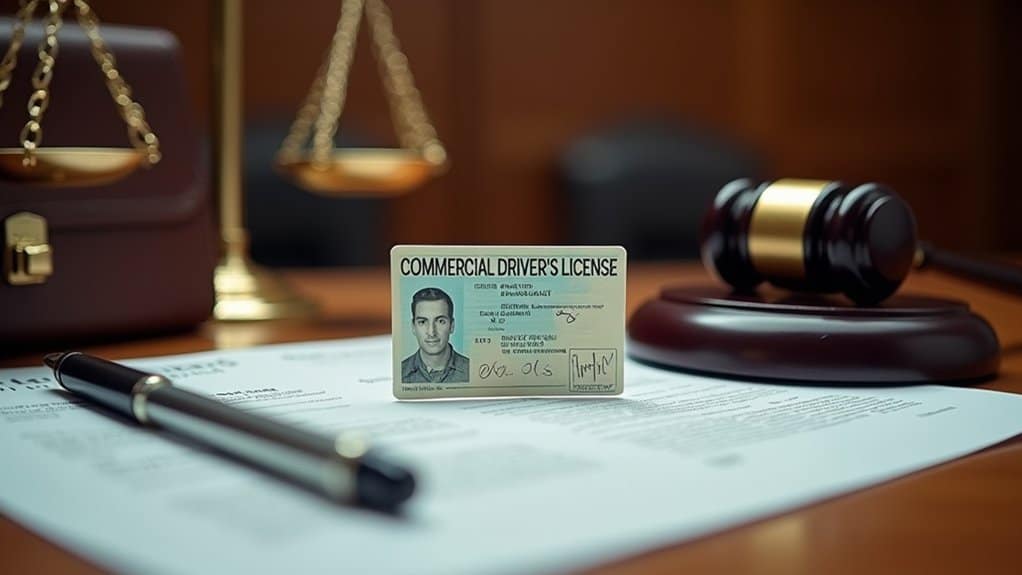
Even when you’re off the clock and behind the wheel of your personal car, a DUI conviction doesn’t stay in your private life, it follows you straight to your commercial driving career.
Federal regulations don’t distinguish between on-duty and off-duty conduct. The per se threshold commercial drivers face applies regardless of which vehicle you’re operating. Your conviction triggers reporting requirements that affect your entire career trajectory.
What happens after a personal vehicle DUI:
- You must notify your employer within 30 days of conviction
- The violation appears on your MVR and national database records
- Background checks reveal the offense to future employers
- Logbook compliance becomes irrelevant during your one-year disqualification
Your termination risk escalates immediately. Many carriers enforce zero-tolerance policies, ending employment upon arrest, not conviction.
How BAC Penalties for CDL Holders Vary by State
While federal law sets the 0.04% BAC floor for all CDL holders nationwide, individual states can, and do, layer additional requirements and penalties that exceed federal minimums.
Virginia enforces the federal 0.04% threshold with escalating jail time based on BAC levels, mandatory minimums increase considerably once you exceed 0.15%. Maryland, however, sets its commercial driver threshold at 0.07%, creating a different compliance landscape. Virginia enforces the federal 0.04% threshold with escalating jail time based on BAC levels, mandatory minimums increase considerably once you exceed 0.15%. Maryland, however, sets its commercial driver threshold at 0.07%, creating a different compliance landscape. Understanding zero tolerance bac meaning is also important in this context, as it refers to laws that prohibit any measurable alcohol level for certain drivers, typically those under 21 or operating under restricted license conditions.
During a roadside inspection, a breath alcohol technician administers an evidential breath test. If results indicate impairment, you’ll face a confirmatory test. Any violation gets reported to the Drug and Alcohol Clearinghouse, potentially affecting your DOT physical eligibility and employment prospects.
You must understand your state’s specific thresholds because ignorance won’t protect your CDL or career.
Your Recovery Journey Begins Here
Alcohol addiction can turn your life upside down for you and everyone who loves you, but healing is always possible. At Alcohol Awareness, we are committed to helping you discover the right Alcohol Recovery Programs to rebuild your life and embrace a brighter tomorrow. Call (855) 955-0771 today and make the decision that could transform your life.
Frequently Asked Questions
Does a DUI From Years Ago Still Show up in the FMCSA Clearinghouse?
Yes, it can still appear. The Clearinghouse retains violation records for five years from the determination date. If you haven’t completed the return-to-duty process and follow-up testing, your violation stays visible indefinitely. Even after you’ve finished RTD requirements, the five-year minimum still applies. Employers query this database before hiring and annually, so you should assume prospective employers will see any unresolved or recent violations during that window.
Can I Get My CDL Back After a Lifetime Disqualification for DUI?
Yes, you may be able to petition for CDL reinstatement after a lifetime disqualification, but only after serving at least ten years and completing required rehabilitation programs. Under Ohio law and federal guidelines, you’ll need to pay reinstatement fees, provide SR-22 insurance, and retake CDL tests. However, certain offenses, like using a commercial vehicle in a felony, result in permanent disqualification with no reinstatement option available.
Will My Employer Be Notified Immediately if I Fail a DOT Alcohol Test?
Yes, your employer will be notified promptly. The breath alcohol technician reports results directly to your employer in a timely and confidential manner. If you test at 0.04 or higher, your employer must immediately remove you from safety-sensitive functions, they won’t wait for written documentation before acting. You won’t receive advance notice, and the removal happens before you’re formally notified in writing. This rapid response protects public safety and guarantees DOT compliance.
What Happens if I Refuse a Breathalyzer Test as a Commercial Driver?
If you refuse a breathalyzer test, you’ll face serious consequences under implied consent laws. Your CDL will be disqualified for one year, even if you’re driving your personal vehicle. A second refusal can result in permanent CDL revocation in some states. You’ll also face separate administrative penalties on your personal license, and the refusal can be used as evidence against you in court. You have just 10 days to request a formal review hearing.
Do CDL BAC Rules Apply When Driving a Rented U-Haul for Personal Use?
The 0.04% BAC limit typically applies only when you’re operating a commercial motor vehicle for commercial purposes. If you’re driving a U-Haul for personal use, the standard 0.08% limit generally applies. However, don’t overlook the bigger risk: any DUI conviction, even in a personal vehicle, triggers automatic CDL disqualification. You’d still face a one-year suspension regardless of which BAC threshold you violated.